You don’t need a power saw to make clean, accurate cuts in drywall. Professional installers routinely rely on a manual technique called the score-and-snap method, which uses only a utility knife and a straight edge to deliver straight, clean edges. This approach is faster, quieter, and produces far less dust than any saw, making it perfect for DIY repairs, patch jobs, or full-sheet installations. Whether you’re trimming around an outlet or fitting a full sheet to your wall, you can achieve professional results without ever plugging in a tool. In this guide, you’ll learn the exact steps, tools, and pro tips to cut drywall cleanly on a wall without a saw.
Score-and-Snap: The Professional Method for Cutting Drywall Without a Saw
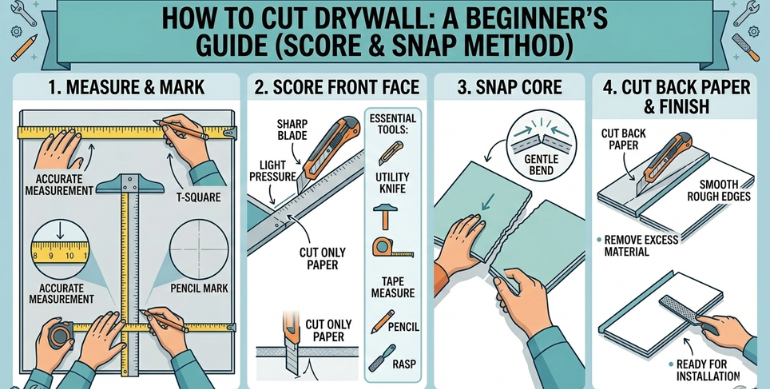
The core technique for cutting drywall on a wall without a saw takes advantage of the material’s structure: a brittle gypsum core sandwiched between two paper facings. By scoring the front paper and snapping the board, you create a clean break along the line, much like snapping a chocolate bar.
Mark the Cut Line Accurately
Before you cut drywall without a saw, precision in measurement is critical.
- Use a tape measure to determine the exact length or position of the cut.
- Mark the line clearly with a pencil on the face side of the drywall (the smoother, lighter side).
- Align a straight edge, such as a metal ruler, level, or 48-inch drywall square, over the line.
• Press firmly to prevent shifting during scoring.
• For full-width cuts, a drywall square ensures alignment across the entire span.
Pro Tip: Use the edge of a stud or existing trim as a reference point when measuring. Double-check your dimensions before scoring to avoid costly mistakes.
Score the Face Paper
This step creates the weak point where the drywall will break cleanly.
- Use a sharp utility knife with a fresh blade. Dull blades tear paper and cause jagged edges.
- Hold the knife against the straight edge and draw it along the line with firm, even pressure.
- Cut only through the front paper layer. Do not slice into the gypsum core.
• Use one or two smooth passes. Avoid sawing back and forth.
• The score should be deep enough to fully sever the paper fibers.
Warning: Never attempt to cut all the way through the drywall at this stage. The goal is to weaken the surface, not remove material.
Snap the Drywall Along the Line
With the front paper scored, the board is ready to break.
- Flip the drywall so the scored side faces down.
- Grip both sides of the sheet near the score line.
- Apply upward pressure with your hands or knee behind the cut line.
• For long cuts, use your knee to push up while holding the outer edges down.
• Bend slowly and evenly to avoid chipping the edges.
You’ll hear a clean crack as the gypsum core snaps along the scored line. The back paper will remain intact, holding the pieces together temporarily.
Trim the Back Paper
Final separation requires one last cut.
- Bend the broken edge slightly to expose the uncut back paper.
- Run the utility knife along the back edge in a single, smooth motion to sever the paper.
- Lightly trim any loose fibers or rough spots for a clean finish.
Expert Note: Always cut the back paper from the back side to prevent tearing the front-facing edge.
Essential Tools for Cutting Drywall Without a Saw
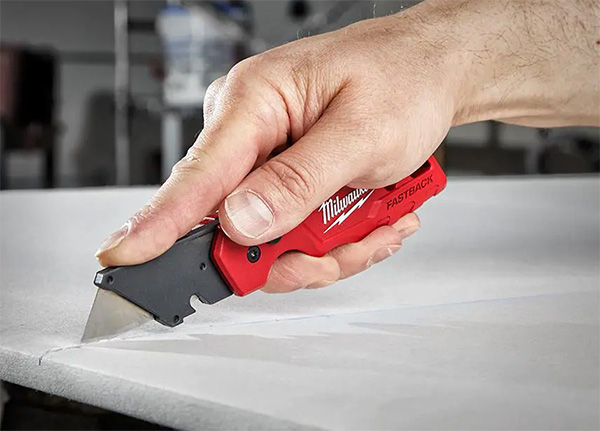
You don’t need many tools to cut drywall on a wall without a saw. You just need the right ones.
Utility Knife With Sharp Blades
The most important tool for this job is a utility knife.
- Use a retractable utility knife for safety and control.
- Change the blade after every few cuts. Drywall dulls blades quickly.
- Alternatives include a high-quality X-Acto knife or craft knife for small, detailed cuts.
Straight Edge for Precision
A straight edge ensures your cut stays true.
- A 48-inch drywall square is ideal for full-sheet cuts.
- A level or metal ruler works great for shorter lines or vertical cuts.
- Avoid flimsy plastic rulers because they flex and cause crooked lines.
Measuring and Marking Supplies
- A tape measure provides accurate dimensions.
- Use a standard #2 pencil for visible, erasable lines.
- A carpenter’s square helps mark perpendicular cuts.
Safety Gear
Drywall is deceptively sharp, so protection matters.
- Safety goggles protect eyes from falling gypsum dust.
- Work gloves prevent paper cuts from sharp drywall edges.
Alternative Manual Methods to Cut Drywall Without a Saw
If the score-and-snap method isn’t suitable for your project, these alternatives work without a power saw.
Use a Hacksaw Blade
This works best for small trims or tight spaces.
- Break off a hacksaw blade and hold it in your hand.
- Cut through the drywall like a serrated knife. The rigid blade keeps the line straight.
- This method works well near studs where snapping isn’t possible.
Advantage: You get more control than with a saw, with minimal risk to underlying wood.
Try a Jab Saw (Drywall Saw)
Despite the name, this manual tool differs from power saws.
- Jab saws have fine teeth and a pointed tip for starting cuts in the middle of a sheet.
- They’re ideal for outlet cutouts or irregular shapes.
- Use short, controlled strokes to avoid hitting studs.
Caution: Keep fingers clear. This tool can slip and cause knuckle injuries.
No Tools? Use a Broken Blade
In an emergency, you can still cut drywall without a saw.
- A broken hacksaw blade or sturdy pocket knife can work.
- Score deeply and make multiple passes.
- This approach is slow and labor-intensive but functional in a pinch.
| Method | Best For | Dust Level | Skill Level |
|---|---|---|---|
| Score-and-Snap | Straight cuts, full sheets | Very Low | Beginner |
| Hacksaw Blade | Trims, small sections | Low | Intermediate |
| Jab Saw | Outlets, center cuts | Moderate | Intermediate |
Fixing Common Problems When Cutting Drywall Without a Saw
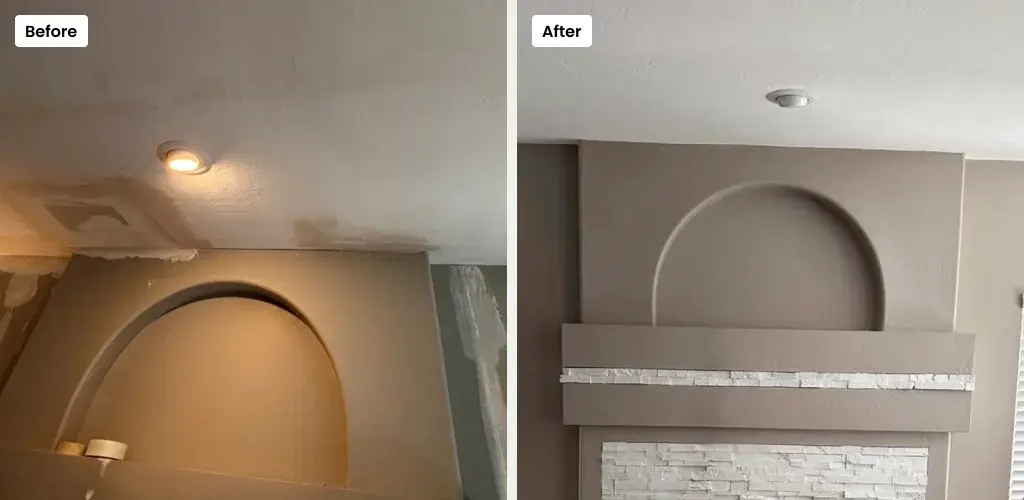
Even pros make mistakes. Here’s how to fix them.
Ragged or Torn Edges
Cause: Dull blade or uneven pressure during scoring.
Fix: Always use a fresh blade. Make one firm, continuous pass instead of multiple light ones.
Uneven Snap or Crumbling Core
Cause: Scored too deep or too shallow.
Fix: Rescore with light pressure, cutting only the paper. Then snap gently with even force.
Drywall Won’t Snap
Cause: Incomplete score line or thick, hard drywall such as moisture-resistant types.
Fix: Extend the score across the entire line. Use your knee to apply leverage for thicker boards.
Accidentally Cut Into a Stud
Cause: Using a jab saw or hacksaw blade at an angle.
Fix: When near studs, keep blades parallel to the wall. For score-and-snap, risk is minimal since it doesn’t cut deep.
Pro Tips for Flawless Results When Cutting Drywall Without a Saw
Go beyond basic cuts with these professional enhancements.
Feather the Cut Edge
After cutting, lightly sand or bevel the edge with a rasp or sanding block.
- Creates a slight taper that helps joint compound blend smoothly.
- Reduces visible seams after taping.
Use the Patch to Mark the Wall
For repairs, this trick guarantees a perfect fit.
- Cut the replacement piece first.
- Hold it over the hole and trace its outline.
- Cut along the traced line.
This approach eliminates measurement errors and ensures precision.
Check Behind the Wall First
This is a critical safety step before you cut drywall on a wall without a saw.
- Confirm no wires, pipes, or ducts are behind the area.
- Use a stud finder with AC detection.
- Knock lightly to listen for obstructions.
- Never assume, because cutting into a wire can be dangerous.
Wet the Edge Before Taping
Before applying joint compound, prepare the edge properly.
- Lightly brush water on the cut edge.
- This prevents the dry core from absorbing moisture too fast.
- It reduces cracking and improves adhesion.
When to Use Each Method to Cut Drywall Without a Saw
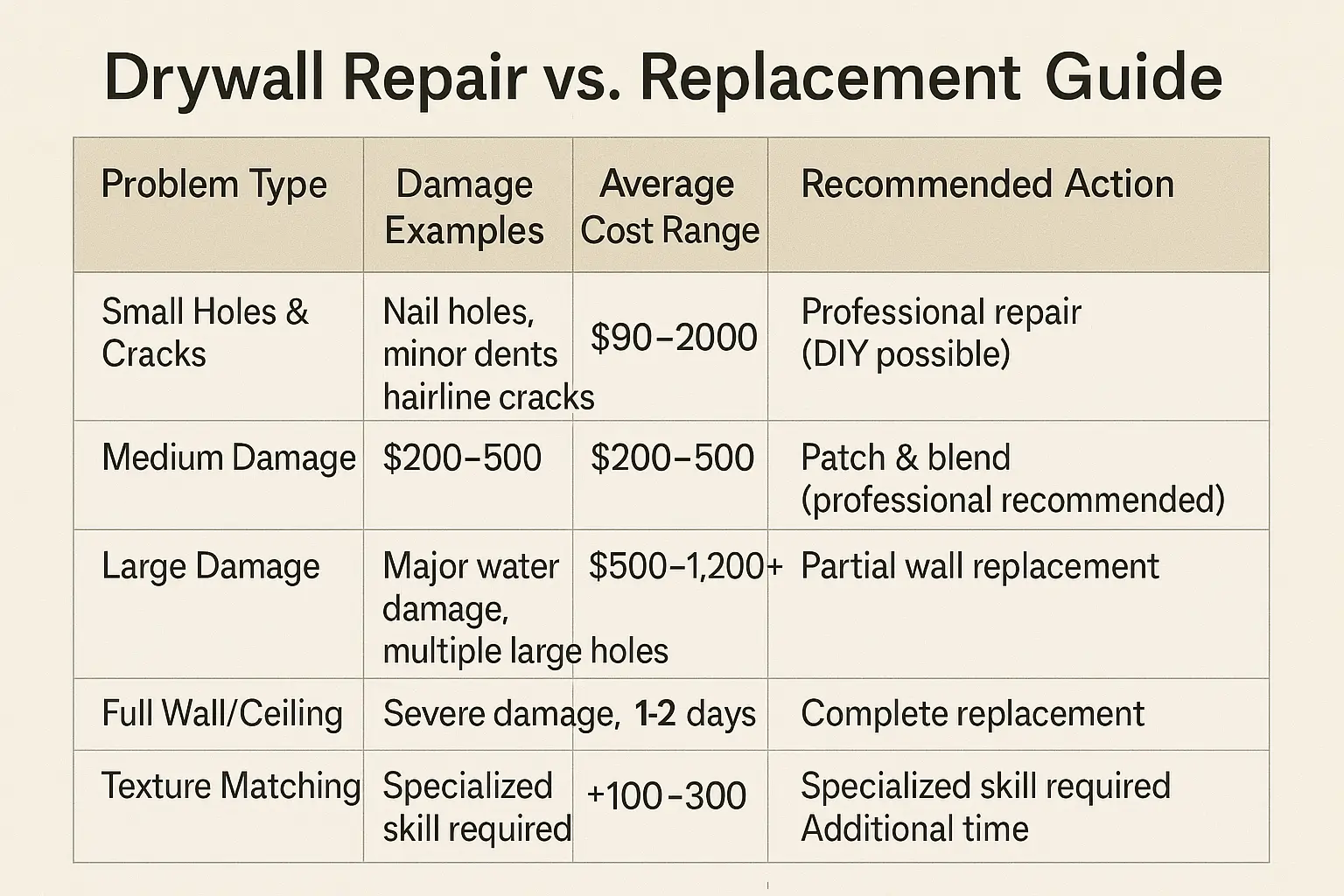
Match the technique to your specific project.
Small Repairs or Outlet Holes
Best method: Utility knife or jab saw.
Score-and-snap works for straight edges, while a jab saw excels at starting cuts in the middle of a wall.
Full-Sheet Installation
Best method: Score-and-snap with a 48-inch square.
This is the industry standard for speed and accuracy, allowing full-width cuts in seconds with minimal cleanup.
Cutting Near Studs
Best method: Score-and-snap or hacksaw blade.
These provide maximum control to stop exactly at the stud without damaging wood framing.
No Tools On Hand
Best method: Broken hacksaw blade or pocket knife.
This is functional in emergencies. Prioritize blade stability and safety above all else.
Frequently Asked Questions About Cutting Drywall Without a Saw
Can you cut drywall without any power tools?
Yes. The score-and-snap method uses only a utility knife and straight edge. This manual technique is the industry standard for straight cuts and produces professional results with zero noise and minimal dust.
What is the best tool to cut drywall without a saw?
A sharp utility knife paired with a 48-inch drywall square is the best combination. The knife scores the paper while the square keeps your line perfectly straight across the full width of the sheet.
How do you cut drywall that’s already on the wall?
Score the face paper with a utility knife along your marked line. Cut only through the paper layer, then snap the board by applying pressure behind the cut. Finally, trim the back paper to complete the separation.
Will a utility knife cut through drywall?
A utility knife cuts through the paper facing easily but should only score the surface during the first pass. Cutting all the way through requires multiple steps: score, snap, then trim the back paper separately.
How do you cut a hole in drywall for an outlet without a saw?
Use a jab saw or score-and-snap method. For square cutouts, score the outline with a utility knife, then snap out the center. For round outlet holes, a jab saw with a pointed tip works best.
Is it safe to cut drywall without checking for wires first?
No. Always verify there are no electrical wires, plumbing pipes, or HVAC ducts behind the cut area. Use a stud finder with AC detection and knock lightly to listen for obstructions before making any cuts.
Key Takeaways for Cutting Drywall on a Wall Without a Saw
Cutting drywall on a wall without a saw is not just possible. It is often the better choice for both DIYers and professionals. The score-and-snap method delivers fast, clean, and precise results using only a sharp utility knife and a straight edge. By scoring the face paper, snapping the core, and trimming the back, you achieve professional-grade edges with zero dust and noise. Always use a fresh blade, measure twice, and check for hidden utilities before cutting. Grab your utility knife and straight edge, and try the score-and-snap method on your next drywall project.