Watching a band saw glide through thick hardwood or slice cleanly through metal pipe, you might find yourself asking: how does a band saw work? Unlike a circular saw that spins or a table saw that pushes material past a rising blade, this tool uses a continuous loop of flexible metal stretched between two wheels. That unique design delivers precision, control, and a level of safety most other saws simply cannot match.
In this guide, you’ll learn the core mechanics of how a band saw works, from its downward cutting vector to its blade guidance system. We’ll cover tension setup, drift compensation, resawing techniques, curve cutting, metal applications, and the safety protocols that keep every cut smooth and controlled.
The Core Mechanism: Continuous Blade Loop System
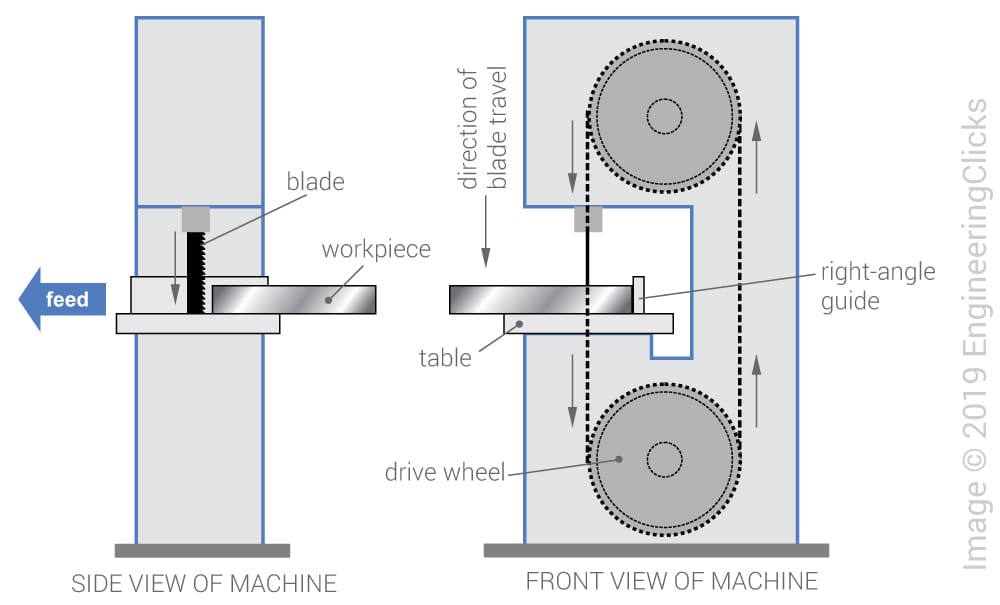
At the heart of every band saw is a continuous band of metal that runs in a loop around two large wheels. One wheel is powered by a motor (the drive wheel), while the other spins freely (the idler wheel). This setup creates a constant, unidirectional cutting motion that travels vertically downward through the workpiece.
The motor typically drives the lower wheel, while the upper wheel adjusts up and down to set blade tension. Because the blade is thin and flexible, it can follow curved paths when guided by hand, yet still cut straight when supported by a fence. This is the foundation of how a band saw works and why it stands apart from rotary saw designs.
Downward Cutting Vector Explained
The blade moves in a single direction, almost always downward, creating a predictable cutting path. This unidirectional force presses the material firmly into the table rather than pushing it back toward the operator.
- The cutting teeth engage only on the front side of the blade.
- The back edge is supported by thrust bearings to prevent deflection.
- There is no upward-moving blade section, so there is no risk of lifting or throwing the workpiece.
This directional stability lets you pause mid-cut, reposition your hands, or adjust feed rate without losing control. Few other power saws offer that kind of forgiveness.
Two-Wheel Drive Configuration
Most band saws use either a bottom-drive or dual-wheel arrangement:
- Bottom-drive models house the motor beneath the table, driving the lower wheel. These tend to have better balance and reduced vibration.
- Top-wheel adjustment allows for blade tensioning via a knob or lever that raises or lowers the upper wheel.
Proper wheel alignment ensures the blade tracks correctly and does not wander. Misaligned wheels lead to poor cuts, rapid blade wear, or derailment.
Blade Guidance: How Stability Is Maintained

Because the band saw blade is inherently flexible, it relies on a precision guidance system located above and below the table to maintain accuracy during cutting. Without these guides, even slight pressure would cause the blade to flex sideways or twist, resulting in crooked cuts or blade failure.
This guidance system is what allows a thin, flexible blade to deliver clean, accurate results across a wide range of materials.
Side Guides Prevent Lateral Flex
Ball-bearing or block-style side guides press lightly against the sides of the blade, just behind the teeth.
- Positioned within 1/16 inch of the blade without actually touching it.
- Prevent side-to-side movement during aggressive cuts.
- Adjustable to accommodate different blade widths.
For best results, set the top guide as close to the workpiece as possible. This minimizes unsupported blade length and increases rigidity during the cut.
Thrust Bearings Control Backward Push
Thrust bearings sit directly behind the blade, stopping it from being forced backward during cutting, especially in resawing or dense materials.
- One set sits above the table, one below.
- They engage the flat back of the blade, not the teeth.
- They reduce blade buckling when pushing through thick stock.
Misadjusted thrust bearings increase friction and wear. Too tight, and they overheat the blade. Proper setup ensures smooth operation and extended blade life.
Why Band Saws Eliminate Kickback
One of the most significant advantages of how a band saw works is its near-total elimination of kickback, a dangerous phenomenon common with table saws. Kickback occurs when a blade catches the workpiece and hurls it back toward the operator, often when the rising blade pinches the wood or encounters twisted grain.
With a band saw, the blade moves straight down, pressing the material into the table. Even if the blade binds, the force vector is downward, not rearward.
- The workpiece stays firmly planted.
- There is no backward thrust to launch material.
- You can safely cut warped, cupped, or knotty wood.
This makes the band saw one of the safest options for ripping irregular lumber or processing green logs.
Safe Handling of Distorted Stock
Woodworkers frequently use band saws to rip twisted or cupped boards that would be hazardous on a table saw.
- The flexible blade follows the natural curve of the wood.
- Downward pressure prevents sudden binding.
- Hands remain clear of the cut zone due to controlled feed.
For turners and artisans, this capability is essential when converting rough logs into usable blanks.
Blade Tension: The Critical Setup Variable
Correct blade tension is critical, more so than on almost any other saw. Too loose, and the blade wanders. Too tight, and it risks breaking or damaging the machine.
Tension is adjusted via a knob or lever on the top of the saw, which moves the upper wheel up or down to stretch the blade.
How Width Affects Tension Needs
Blade width directly determines how much tension it requires:
| Blade Width | Recommended Tension Level |
|---|---|
| 1/8 inch | Low |
| 1/4 inch | Medium |
| 1/2 inch | High |
| 3/4 inch | Maximum |
Wider blades resist deflection but need higher tension to stay rigid. Narrower blades require less tension but are prone to wandering on straight cuts.
Signs of Improper Tension
Under-tensioned blade:
– Wanders off course
– Produces crooked cuts
– Vibrates excessively
– May derail from wheels
Over-tensioned blade:
– Risks immediate breakage
– Stresses wheel bearings
– Can warp the frame over time
Always refer to your saw’s tension gauge or manufacturer specs. When in doubt, start low and gradually increase until the blade hums steadily without shaking.
Pro Tip: Keep multiple blades on hand and switch widths based on project needs to avoid over-tensioning a narrow blade.
Blade Drift and Fence Compensation
Even with perfect setup, most band saw blades exhibit drift, a natural tendency to veer slightly off a straight line due to blade stress, tooth set, or guide alignment. This is not a flaw. It is a fact of operation. The solution is not forcing the blade straight, but compensating with the fence.
Adjusting the Fence for Drift
To make accurate rip cuts or resaw thick stock:
- Make a test cut in scrap wood.
- Observe which way the blade drifts (left or right).
- Angle the rear of the fence slightly to match the drift angle.
- Keep the front aligned with the blade.
Now, as the workpiece contacts the angled fence, it is gently steered along the intended path while the blade follows its natural arc. This technique allows for precise, repeatable cuts without fighting the tool.
Freehand Curve Cutting Advantage
When cutting curves, remove the fence entirely. The downward force of the blade holds the workpiece securely, allowing you to:
- Pause and reposition hands
- Rotate the piece gradually
- Follow complex patterns with control
Because there is no kickback, you can stop and restart safely. This is ideal for intricate scrollwork or bandsaw box projects.
Resawing: Cutting Thick Boards into Thin Stock
Resawing is the process of cutting a board lengthwise into thinner slices, and it is where the band saw truly shines. Compared to a table saw, it wastes far less material thanks to its narrow kerf (the width of the cut). A typical band saw blade removes only 1/16 inch to 1/8 inch of wood per pass, preserving valuable hardwood.
Why Resawing Works So Well
- Less material loss means more usable lumber from each board.
- Book-matching capability creates symmetrical grain patterns for panels or doors.
- Handles thick stock, including logs or slabs over 10 inches thick on larger models.
To resaw effectively:
– Use a wide blade (1/2 inch to 3/4 inch) for stability.
– Ensure maximum blade tension.
– Support long boards with roller stands.
– Apply steady, even feed pressure.
Furniture makers rely on this process to produce matching veneers, solid tabletops, and custom thicknesses not available commercially.
Curve Cutting: Matching Blade Width to Radius

The band saw is unmatched for cutting smooth, tight curves in wood. Its ability to handle arcs depends almost entirely on blade width. The narrower the blade, the tighter the turn it can make.
Matching Blade to Curve Radius
| Blade Width | Minimum Achievable Radius |
|---|---|
| 1/8 inch | ~1/4 inch |
| 1/4 inch | ~3/4 inch |
| 1/2 inch | ~2 inches |
| 3/4 inch | ~6+ inches |
A 1/4-inch blade is a popular choice for general curve work, offering a good balance between maneuverability and straight-cut stability.
Tips for Clean Curves
- Feed at a consistent pace and avoid forcing or slowing down abruptly.
- Look ahead of the cut, not directly at the blade, similar to steering a car.
- Relieve internal stress by making relief cuts inside tight curves.
- Sand after cutting, since the band saw leaves a slightly wavy edge that sands easily.
Artisans use this capability for cabriole legs, scrollwork, musical instruments, and decorative inlays.
Metal Cutting Applications and Differences
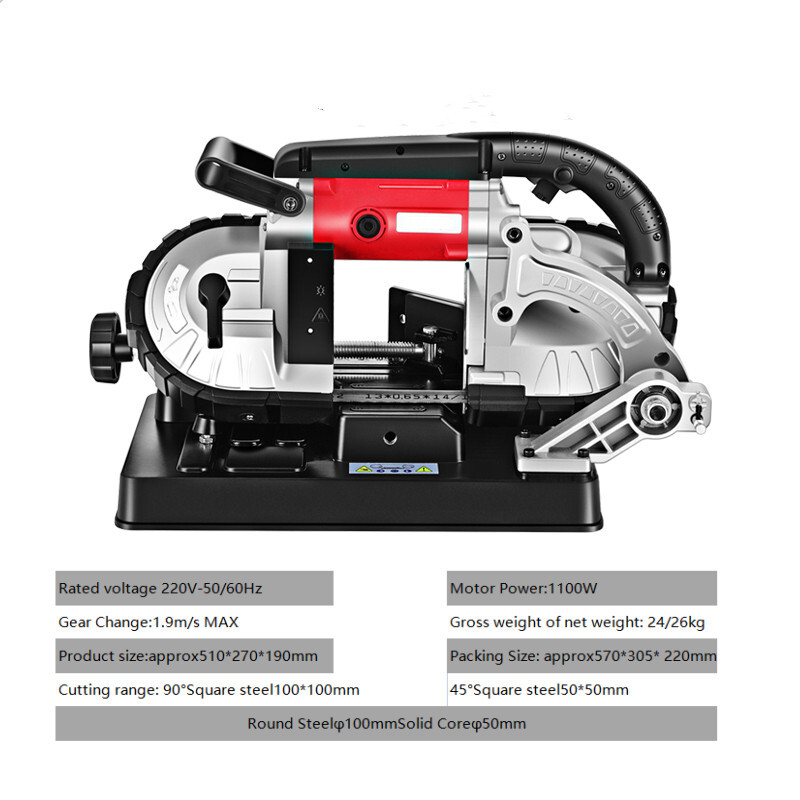
While often associated with wood, band saws are also vital in metal fabrication. Portable models are standard tools for electricians, plumbers, and welders cutting conduit, pipe, strut, and angle iron.
How Metal Band Saws Differ
- Blade speed is slower and often adjustable based on material.
- Blade tooth count varies:
- Coarse (3 to 6 TPI) for thick steel
- Fine (14 to 32 TPI) for thin wall tubing
- The operator does not push down. The weight of the saw provides feed pressure.
Applying extra force causes blade breakage. Let the tool do the work.
Safety First in Metal Cutting
- Wear cut-resistant gloves and safety glasses, since flying chips are sharp and hot.
- Secure the workpiece in a vise or clamp. Never hold by hand.
- Use a back plate to stabilize the cut and prevent binding.
- Start cuts from the side, not the front edge, to avoid jerking.
- Wait for the blade to stop before handling or deburring.
Handheld metal band saws often feature thumb-activated interlocks to prevent accidental starts.
Choosing the Right Blade Width

Selecting the correct blade width is essential for performance and safety. Each width serves a specific purpose, and using the wrong one leads to poor cuts or broken blades.
Blade Width Application Guide
| Width | Best For | Avoid Using For |
|---|---|---|
| 1/8 inch | Tight curves, intricate scrollwork | Straight ripping, resawing |
| 1/4 inch | General curves, medium-thick stock | Heavy resawing, wide planks |
| 1/2 inch | Ripping, light resawing | Very tight curves |
| 3/4 inch | Heavy resawing, thick hardwoods | Any curve tighter than 6 inches |
Always match blade width to task, and adjust tension accordingly.
Band Saw Size and Throat Capacity
Band saw size refers to throat capacity, the distance from the blade to the vertical frame (column) of the machine. This determines the maximum width of material you can cut before the frame blocks the path.
Common Sizes and Uses
- 14-inch: Ideal for hobbyists; handles most home shop tasks.
- 16-inch: Popular with furniture makers; offers better resaw capacity.
- 18-inch and up: Professional use; cuts wide slabs and large logs.
A 14-inch saw can rip a board up to 14 inches wide. Beyond that, the frame interferes. Many users upgrade to cast-iron extension tables for larger workpieces and better fence support.
Safety Protocols for Wood and Metal Cutting
Even with inherent safety advantages, improper use can lead to injury. Follow these rules every time you operate a band saw.
Woodworking Safety
- Keep hands clear and never push from the front at the end of a cut.
- Use a push stick when nearing the blade.
- Wait for full stop before clearing scraps under the table.
- Inspect the blade guard before each use.
Metal Cutting Safety
- Always wear PPE: safety glasses, gloves, and hearing protection.
- Secure the workpiece. Never cut freehand.
- Do not force the cut. Let the blade speed do the work.
- Deburr edges immediately, since metal shards are extremely sharp.
General Maintenance Tips
- Release tension when storing (on some models).
- Clean wheels and check for gum buildup.
- Replace worn or cracked blades promptly.
- Lubricate pivot points and blade guides periodically.
Band Saw Compared to Other Saws
| Feature | Band Saw | Table Saw | Jigsaw |
|---|---|---|---|
| Curve Cutting | Excellent | None | Good |
| Resawing | Superior | Possible (wasteful) | No |
| Kickback Risk | Nearly None | High | Low |
| Material Waste (Kerf) | Minimal | Moderate | Moderate |
| Straight Ripping | Moderate (with drift) | Fast and precise | Poor |
| Thick Stock Handling | Excellent | Limited by height | Poor |
The band saw does not replace the table saw, but it complements it perfectly. Together, they cover nearly every woodworking task.
Frequently Asked Questions About How a Band Saw Works
What makes a band saw different from a table saw?
A band saw uses a continuous loop of flexible blade moving downward, while a table saw uses a circular blade rising through the table. The downward motion of a band saw eliminates kickback and allows for curve cutting, resawing, and handling warped stock safely.
Why does a band saw have less kickback risk?
Because the blade travels straight down, the cutting force pins the workpiece to the table rather than pushing it back toward the operator. Even if the blade binds, there is no rearward force to launch the material.
How tight should a band saw blade be?
Tension depends on blade width. Narrow blades (1/8 inch) need low tension, while wide blades (3/4 inch) need maximum tension. Refer to your saw’s manual and adjust until the blade hums steadily without shaking.
Can a band saw cut metal?
Yes. Portable band saws are widely used in metalworking to cut conduit, pipe, strut, and angle iron. Use blades with tooth counts matched to material thickness, and never force the cut. Let the saw’s weight provide feed pressure.
What blade width should I use for curves?
Narrow blades work best for tight curves. A 1/8-inch blade can cut a radius as small as 1/4 inch, while a 1/4-inch blade handles roughly 3/4-inch radius curves. For general curve work, a 1/4-inch blade offers the best balance.
How do I fix blade drift on a band saw?
Make a test cut in scrap wood to identify the drift direction. Then angle the rear of your fence to match that drift while keeping the front aligned with the blade. This compensates for the blade’s natural arc without forcing it.
Key Takeaways for Mastering How a Band Saw Works
Understanding how a band saw works transforms it from a simple cutting tool into a precision instrument capable of resawing, curve cutting, and handling challenging materials safely. Its continuous blade loop, downward cutting vector, and guidance system combine to deliver unmatched versatility and control.
The three most important points to remember:
- The downward cutting motion eliminates kickback and pins the workpiece to the table.
- Blade width, tension, and drift compensation directly determine cut quality.
- Matching the right blade to the task